A roofing website should help a homeowner answer a practical question: is this a business I can trust to discuss my roof? Attractive colours and impressive photographs contribute, but they cannot replace clear service information, convincing evidence and an easy next step. Planning these essentials before choosing a layout reduces confused pages and expensive rewrites. It also gives everyone involved a shared definition of a useful finished website.
Start with the decisions customers need to make, then build the site around those decisions. You do not need dozens of pages immediately. You need a sensible structure, accurate content and a reliable way for suitable enquiries to reach your team.
Decide what the website needs to achieve
Write down your main commercial objective in one sentence. You might want more enquiries for roof replacements, better qualified requests for repairs, or a clearer introduction for customers who already heard your name. These objectives overlap, but they lead to different priorities. A business concentrating on planned replacement projects needs enough explanation and examples to support a considered decision. A repair enquiry may need a much shorter route to contact.
Choose a primary action that your team can handle consistently. That might be a phone call, an enquiry form or a request for a site visit. Explain what happens after someone takes that action. Avoid promising an immediate response unless you can reliably provide one. A modest, accurate expectation is more useful than an impressive promise that the office cannot keep.
Identify the customers you want to help
List the types of properties, projects and customers your business is actually equipped to serve. Distinguish between work you regularly undertake and work you only occasionally accept. Your website should make that distinction understandable without turning into an internal operations manual. Customers should recognise their situation quickly and understand when to contact you for clarification.
Consider the questions people ask before booking a visit. They may want to know whether you handle their roof type, whether smaller jobs are welcome, or what information to send. Use real questions from calls and enquiries as planning material. Remove personal information when sharing examples with your designer or writer, and avoid assuming every visitor already understands roofing terminology.
Create a small, logical page structure
Most roofing businesses can begin with a homepage, individual pages for core services, an about page, a project gallery and a contact page. Each page should have a distinct purpose. The homepage introduces the business and directs visitors. A service page explains a particular kind of work. A project page shows relevant evidence. The contact page makes the next step straightforward.
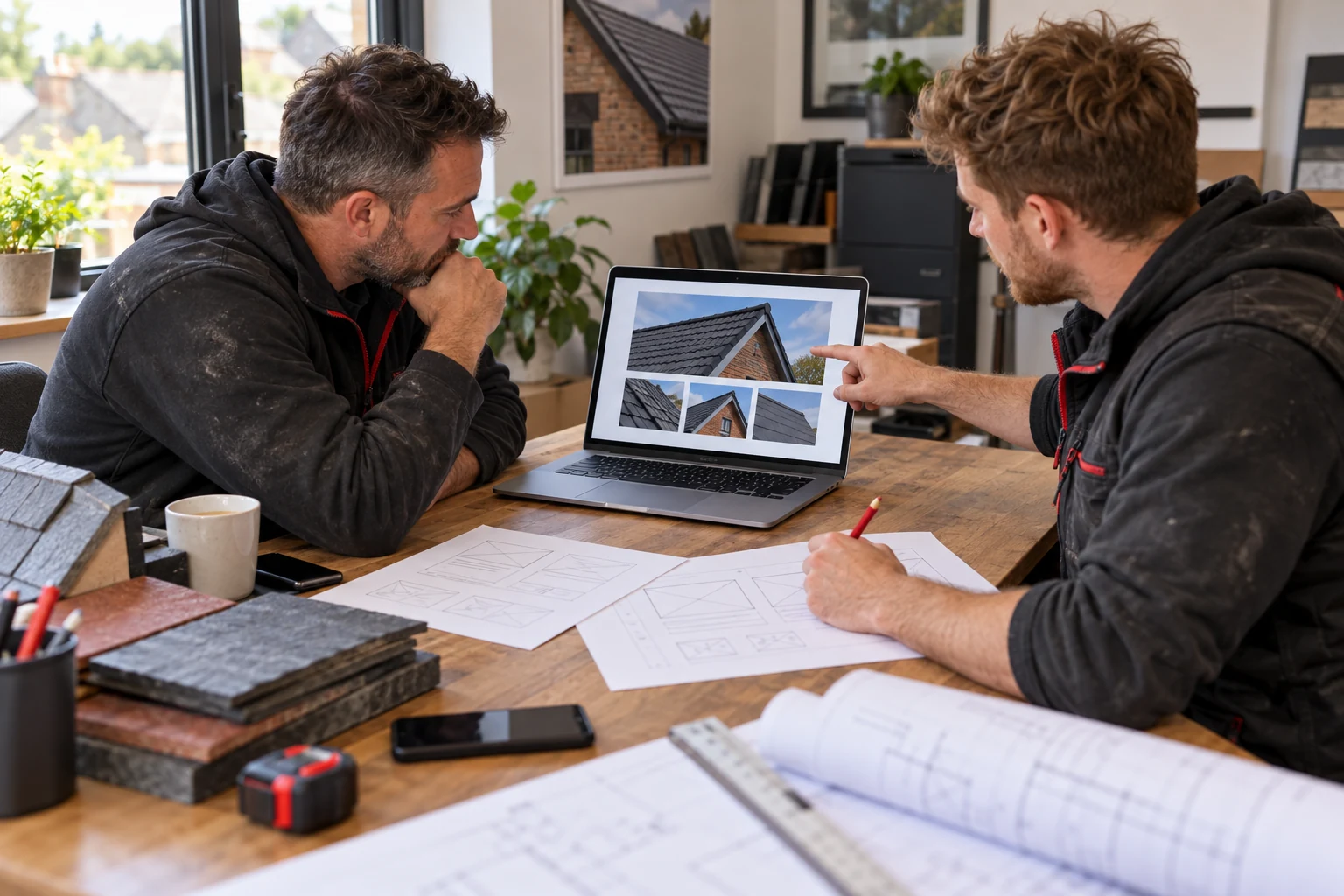
Map these pages on paper before writing them. Draw the likely route from a service page to a suitable project example and then to contact. If a page has no clear reason to exist, combine it with a stronger page or postpone it. A smaller site with useful information usually serves visitors better than a large collection of repetitive pages.
Gather evidence before writing claims
Create a folder containing approved photographs, accurate business details, genuine customer feedback and documents supporting any credentials you intend to mention. Confirm permission to publish customer quotes and project images. Keep a note of what each photograph shows so that captions describe the actual project rather than making assumptions about materials or work performed.
Check every proposed claim against evidence. Avoid unsupported language such as guaranteed best prices or industry leading results. If a guarantee applies only to particular work, explain its scope and where customers can obtain the terms. Evidence can be straightforward: a clear project description, an identifiable team and a transparent explanation of your enquiry process often communicate more than broad superlatives.
Write around customer decisions
Draft each page with the visitor's immediate question in mind. Lead with the service or problem, explain how your business approaches enquiries, provide relevant examples and finish with a clear invitation to get in touch. Use everyday language first, introducing technical terms only when they help someone understand their options. Keep paragraphs short enough to scan comfortably on a phone.
Hypothetical example: a homeowner comparing roof replacement companies may need to understand how an initial discussion leads to an assessment and a written proposal. A page outlining those stages can reduce uncertainty. It should not imply that an online description can establish the condition of their particular roof. Leave individual recommendations to the appropriate assessment and conversation.
Plan contact details and enquiry handling
Decide where messages will arrive, who checks them and how they will be recorded. A beautifully designed form is ineffective if submissions reach an unattended inbox. Ask only for information needed to begin the conversation, such as a name, contact method, broad location and short description. Make additional details optional when they are helpful but not essential.
Give visitors a visible telephone option and use consistent contact details across the website. Explain whether photographs can be supplied later. Consider how you will manage enquiries outside normal working hours without creating unrealistic expectations. Write a simple internal checklist for acknowledging messages, identifying suitable work and arranging the next conversation so that the website supports an actual process.
Set a realistic design and maintenance brief
Provide your designer with the page map, content priorities, approved assets and main customer action. Request a design that works on smaller screens, keeps text readable and makes navigation obvious. Agree who owns the domain, hosting account, photographs and final website files. Record how routine changes will be made and who will maintain any software the site requires.
Budget for updates as well as the initial build. New project photographs, changed contact details and improved explanations all need a responsible owner. Choose a publishing approach your business can maintain comfortably. Complex features should earn their place by solving a real problem, rather than being added because another contractor's website happens to include them.
Review the website as a customer
Before launch, ask someone unfamiliar with the business to find a service, explain why they would trust the company and identify the next step. Watch where they hesitate. Test telephone links and enquiry delivery, read the site on a phone and check that photographs support the surrounding text. Correct unclear promises before adding decorative details.
A well planned roofing website provides a dependable starting point for a conversation. It makes the business understandable, supports its claims with relevant evidence and gives suitable customers a practical way forward. Begin with those foundations, then improve the site as your team learns which questions visitors still need answered.
Explore how these ideas connect with your marketing.
Websites for roofing businesses ↗