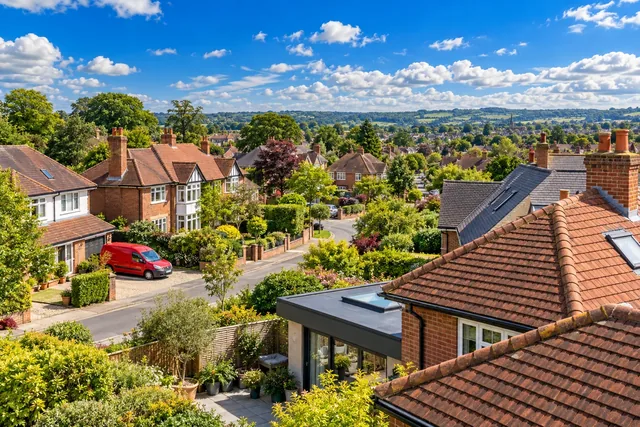

A homeowner looking for a roofer has to make a difficult judgement before anyone visits the property. They cannot inspect your workmanship through a search result, and they may not know the difference between several roofing systems. Useful photography helps bridge that gap. It shows the kinds of homes you work on, the details you care about and the people a customer might meet. The strongest collection is not simply a gallery of attractive finished roofs. It answers practical questions with clear, believable visual evidence that belongs to your business.
Give every photograph a purpose
Before taking another picture, decide what a potential customer needs to understand. A wide view can show the scale and shape of a completed roof. A closer photograph can reveal tidy flashing, an orderly roof edge or the relationship between a roof covering and a nearby chimney. A ground level photograph can show how neatly the property has been left. These images perform different jobs. Gathering several views deliberately produces a more useful collection than taking many nearly identical photographs from the same corner of a garden.
Think about the questions your office hears. Customers may ask whether you work on terraced houses, whether a particular extension is suitable for a flat roof system or whether access through a side passage is possible. Photographs can help explain relevant examples, provided the accompanying words avoid promising that every property will be identical. Build a simple shot list around genuine questions. That gives your team a reason for each photograph and makes the resulting website easier for homeowners to navigate.
Show the roof in its surroundings
A close crop of tiles might demonstrate neat work, but it can leave visitors unsure about the building itself. Include a wider photograph that shows how the roof fits the house. British properties vary considerably, from compact terraces to detached homes and converted buildings. Customers often feel more comfortable when they can recognise a similar setting. This does not require publishing an exact address. A carefully framed view can explain the building type while keeping identifying details outside the image.
Permission matters before publication. Agree with the property owner which photographs may be used, where they may appear and whether any location description is acceptable. Look for house numbers, vehicle registrations, people, security equipment and neighbouring windows before sharing. A photograph can be commercially useful without revealing someone’s private arrangements. When permission is uncertain, choose another image. A smaller collection that you are entitled to use is better than an extensive gallery that creates avoidable concerns for customers or neighbours.
Capture workmanship without creating confusion
Roofing details are often meaningful to a contractor and unfamiliar to a homeowner. Pair a detail photograph with a plain explanation of what the viewer is seeing. Rather than relying on technical terminology alone, describe the purpose of the feature and the work shown. Keep claims proportionate to what the photograph actually demonstrates. A picture of finished flashing can show its visible appearance; it cannot independently prove every hidden construction detail or establish how an unrelated roof should be repaired.
Photographing work in progress can be helpful, but context is essential. An exposed section or temporary protective covering may look worrying when separated from its explanation. Identify the stage clearly and explain why it was photographed. Avoid presenting an unfinished view as a completed result. Where a sequence exists, use it to explain preparation, installation and completion. The aim is understanding, not spectacle. Customers should finish the page with a clearer picture of your process rather than a collection of unexplained construction scenes.
Make photographs comfortable to view
You do not need elaborate equipment to improve a useful photograph. Clean the lens, hold the camera steadily and check that the main subject is sharp. Take a moment to remove an empty drink bottle or loose packaging from the foreground when it is safe and appropriate to do so. Stand where you can explain the work clearly. Avoid extreme wide angle distortion that makes a modest building look strangely stretched or exaggerates the shape of the roof.
Safety comes before the shot. Do not ask anyone to step backwards near an edge, climb somewhere unsuitable or interrupt a careful task for the camera. Many valuable images can be taken from an established safe position or after the work area has been cleared. If aerial photography is proposed, use a competent operator and make appropriate arrangements for the site. A dramatic viewpoint is optional. A clear photograph obtained without unnecessary distraction is usually more useful for everyday customer communication.
Choose a balanced collection
When selecting images for a service page, think in sets rather than individual favourites. One establishing view, one relevant detail and one photograph of the completed surroundings may tell a stronger story than ten distant roof shots. Include different property types when they genuinely reflect your work. Avoid filling the site with images of work you do not offer or materials you rarely install. The visual message should match the enquiries you are equipped to handle.
People can add warmth, but use them deliberately. A team photograph can make the business feel approachable, while a picture of someone explaining a sample can illustrate customer communication. Obtain consent and present staff accurately. Do not suggest that a stock model is your surveyor or that an illustrative house is a completed customer job. If an image is illustrative, its context should make that clear. Trust depends on the whole presentation, including the relationship between the photograph and its caption.
Make the collection manageable
Store approved photographs in a shared folder with understandable filenames. Record the service shown, permission status and any restrictions on use. You do not need to put a customer’s personal details into a public filename. A simple internal note can keep the necessary context separate from the published asset. Mark the images that are approved for your website so that someone updating a page does not have to guess whether a photograph may be used.
Before uploading, prepare a sensible image size and compress the file so visitors are not downloading an enormous original unnecessarily. Write concise alternative text that explains the image where that information is useful. Describe what is visible rather than repeating a list of locations and services. Review the page on a phone as well as a larger screen. Check that the crop still shows the important detail, that captions are readable and that the surrounding text explains why the image belongs there.
Turn better photography into clearer enquiries
The final test is whether your photographs help a homeowner take a sensible next step. A visitor should be able to recognise the kind of work shown, understand your explanation and find a straightforward way to discuss their own property. Keep the contact invitation close to useful information. Ask customers to explain their concern and share their own photographs if your enquiry process supports that securely. Good business photography makes a conversation easier to begin. Galaxy Roofer Marketing can help organise those assets into clearer service pages and a more convincing local website.
Explore how these ideas connect with your marketing.
Local SEO for roofing businesses ↗